Tuning stages
Stage 1 vs Stage 2 Remap: What Changes and What Hardware You Need
Customers ask for "Stage 1" and "Stage 2" as if they were products on a shelf. They are not fixed products. They are a shorthand that the tuning world uses for how much the car has been changed around the calibration. Understanding that shorthand properly is what lets a workshop sell the right job, and say no to the wrong one.
Stage 1: software on a standard car
A Stage 1 remap changes the calibration and nothing else. The car keeps its standard turbo, intercooler, exhaust and intake, and the file works within what those parts can deliver. On a modern turbo engine the main changes are usually to the torque request, boost targets, fuelling and ignition timing on petrol engines, rail pressure and injection on diesels, and the torque limiters that sit between the driver's foot and the engine.
Because the hardware stays standard, a well-made Stage 1 file leaves margin. It should not push exhaust temperatures, turbo speed or injector duty to the edge. That margin is why a Stage 1 car can usually be driven exactly as before, just with more pull in the mid-range.
A Stage 1 file is also the stage where the condition of the car matters most, because nothing has been replaced. A tired turbo or a boost leak that the stock calibration hides will show up the moment the file asks for more. Our pre-tune health check covers what to log before you start.
Stage 2: the calibration follows the hardware
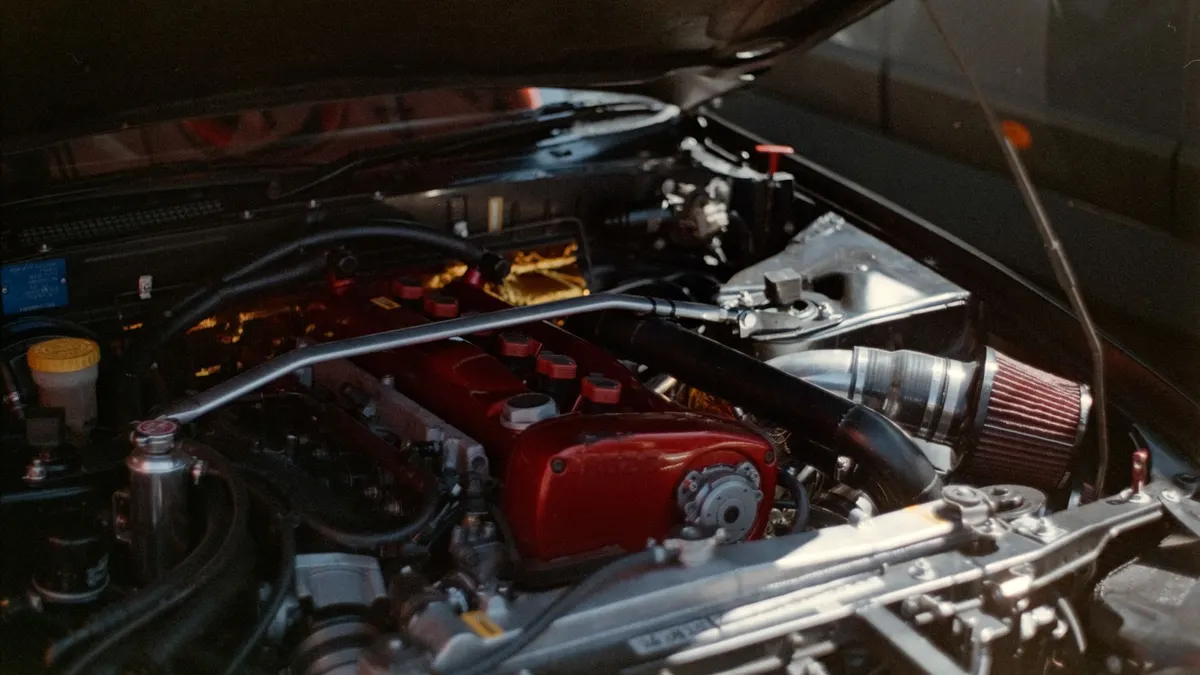
Stage 2 means the car has supporting modifications fitted, and the file is written for them. There is no universal list, but on most turbo cars it includes some combination of these parts:
- A less restrictive downpipe, and sometimes the rest of the exhaust, so the turbo can breathe out.
- A larger or more efficient intercooler, to keep intake temperatures stable on repeated pulls.
- An upgraded intake or turbo inlet on engines where the standard one becomes a restriction.
- On some petrol engines, uprated fuel delivery parts or ignition parts, depending on the platform.
With that hardware in place, the calibration can ask for more boost and more torque without the temperatures and pressures that would hurt a standard car. The numbers go up, but so does the responsibility on the workshop: the file is only safe on the car it was written for.
That is why we always ask for the exact list of modifications in a Stage 2 order. "Downpipe fitted" is not enough. We want to know whether it keeps a catalyst, which intercooler is on the car, and whether anything else has been changed since the original read.
Stage 1 vs Stage 2 at a glance
| Stage 1 | Stage 2 | |
|---|---|---|
| Hardware | Standard | Supporting parts fitted before the file is written |
| What the file assumes | Original turbo, intercooler, exhaust and intake | The exact parts listed in the order |
| Typical use | Daily driving, towing, better mid-range | Enthusiast cars, track days, cars already modified |
| Drivetrain | Often fine on standard clutch and gearbox | More likely to need a clutch upgrade or a TCU file |
| Can it go back to stock? | Yes, with the original read | Yes for the software; the parts have to come off too |
The drivetrain does not read the brochure
Most of the problems we see after a remap are not engine problems. They are clutches that slip under the new torque, or automatic gearboxes that cut power during shifts because their own limits were never raised. Before quoting either stage, check what the clutch or gearbox is rated for and how close the new torque will sit to that figure.
On automatics and dual-clutch boxes a matching gearbox file is often what makes the difference between a car that feels faster and one that just feels different. We explain how to judge that in when an automatic needs a TCU file, and the specific case of VW Group boxes in DSG tuning explained.
Diesel and petrol are not the same conversation
On a diesel, Stage 1 is mostly about torque and fuelling within smoke and exhaust temperature limits. On a turbo petrol engine, ignition timing and knock control become just as important, and fuel quality matters. A Stage 2 petrol file written for a higher octane fuel can behave very differently on the fuel your customer actually buys. Ask the customer which fuel they use, and pass it on with the order.
Which stage should you sell?
For most customers who drive their car every day, a good Stage 1 is the right answer. It gives a clear improvement, keeps the car as reliable as it was, and is easy to undo. Stage 2 makes sense for customers who already want to change hardware, and who accept that the car will need more attention afterwards.
When a customer asks for Stage 2 on a standard car, the honest answer is that Stage 2 starts with parts, not with software. Selling the parts and the file together, in that order, is better business than flashing a file the car is not ready for.
What else changes with the stage
Beyond power, a remap can include options such as launch control, a raised speed limiter or a pop and bang map, where the ECU supports them and local rules allow it. These are separate from the stage. List them in the order so the engineer can check compatibility with the exact software version.
You can see what each stage and option includes on our services page, and the brands we work with most, such as BMW, Mercedes-Benz and Audi, each have their own page with the details that matter on those platforms.
Frequently asked questions
What is the difference between a Stage 1 and a Stage 2 remap?
A Stage 1 remap is a software calibration for a car with standard hardware. A Stage 2 remap is written for a car with supporting modifications already fitted, typically a less restrictive downpipe or exhaust, a larger or more efficient intercooler and an upgraded intake, so the calibration can safely ask for more.
Can I flash a Stage 2 file on a stock car?
No. A Stage 2 file assumes the hardware is installed. On a standard car it can cause overboost, high exhaust temperatures, knock on petrol engines or fault codes. Fit the parts first, then read the car and order the file.
Does a remap need a clutch or gearbox upgrade?
It depends on how close the new torque sits to the limits of the clutch or gearbox. Many Stage 1 cars are fine on the standard parts; Stage 2 cars more often need a stronger clutch or a gearbox calibration. Tell the engineer the gearbox and its condition when you order.
More from the blog
- How to Choose an ECU Tuning File Service: What Workshops Should Check
- KESS3 Master or Slave? Choosing the Right Tool Setup for Your Workshop
- DSG Tuning Explained: DQ200, DQ250, DQ381 and DQ500 Gearboxes
- How to Learn ECU Remapping: A Realistic Training Path for Workshops
- Engine Remap on an Automatic: When the Gearbox Needs Its Own TCU File
- Pre-Tune Health Check: What to Log Before Remapping a High-Mileage Engine
- Before You Upload: How to Take a Clean, Complete ECU Read